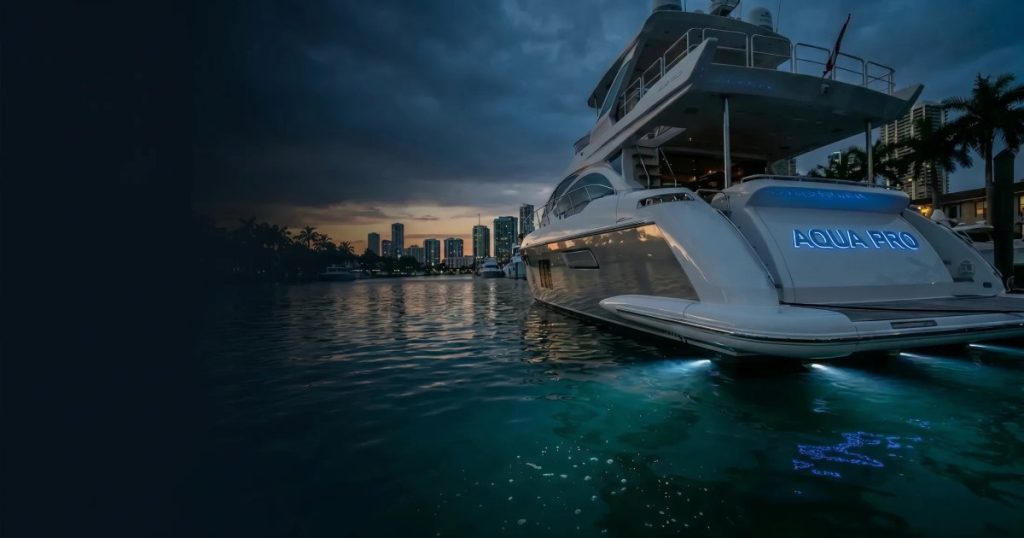
What to expect: a diver in the water for roughly 45 minutes to two hours depending on your length and how long it’s been, a soft-pad pass on the paint, a hard scrub on the running gear, a zinc inspection, and before/after photos sent to your phone. You don’t need to be there, and you don’t move the boat.
Where we dive in Hollywood
Most of our Hollywood work falls into three zones. First, the Intracoastal marinas and dockage between the Sheridan Street bridge and the Hollywood Boulevard bridge, including the city docks near Polk Street and the resort dockage at Diplomat Landing at the south end of town. Second, the residential canal docks — North Lake, South Lake, the Hollywood Lakes streets off Hollywood Boulevard, and the Royal Poinciana and Harbor Islands seawalls. Third, the working waterfront just over the line on the Dania Cut-Off Canal, including Harbour Towne Marina, where a lot of Hollywood owners keep boats they don’t want on a lift.
Those three zones grow completely different things on a hull, which is why “hull cleaning in Hollywood” doesn’t mean one job.
Intracoastal slips vs. Hollywood Lakes canals: two different fouling problems
Boats sitting on the ICW get clean ocean water pushed up from Port Everglades inlet on every flood tide, and clean ocean water carries barnacle larvae. Those slips throw hard growth — barnacles on the running gear, on the trim tabs, in the strut and rudder shadows where the antifouling never gets applied properly. On a boat that’s been sitting three months at a Hollywood ICW slip in July, we routinely find barnacles thick enough on the props that the boat has lost noticeable top-end speed.
The canal docks behind the houses are a different animal. Flow is slow, the water is warmer and darker, and after a summer rain the runoff from the Lakes streets loads it up. Those hulls come up soft — brown slime, long grass on the waterline, and a fuzzy carpet along the keel and the bottom of the rudders. Soft growth looks less alarming than barnacles and costs you just as much fuel. It also holds moisture against ablative paint and burns through it faster if you let it sit and then scrub it hard.
Visibility is under three feet, and that’s normal here
New owners are often surprised that we don’t come up with photos of crystal-clear water. In the Hollywood canals, visibility is frequently one to three feet, and on an outgoing tide after rain it can be arm’s length. Our divers work by feel — you learn a hull by hand, section by section, from the boot stripe down to the keel, then the shafts, struts, rudders, props, intakes and tabs. The before/after photos we send are taken close to the surface with light, which is why they look the way they do. If someone tells you they need clear water to clean a boat in Hollywood, they don’t work in Hollywood.
Zincs go fast on canal docks with shore power
The Hollywood Lakes canals are lined with private docks, lifts, dock boxes and shore power pedestals, sometimes four or five boats within fifty feet of each other. That density is where we see anodes disappear quickly — shaft collars chalked down to the pin, trim tab anodes half gone, pencil zincs in the heat exchanger crumbling. We check every anode on every visit and photograph anything that’s more than half consumed. Zincs, props and running gear work are quoted on site, because a shaft collar on a 34-foot express and a set of anodes on a 60-foot sportfish are not the same conversation.
One more Hollywood-specific note: manatees move into the ICW and the canal mouths in cool months. If one comes to the boat, the diver stops and gets clear. It’s not negotiable and it can add time to the visit.
How often, and what it costs
From roughly May through October, when the water off Hollywood beach is in the mid-80s, hard growth can establish on bare running gear in three to four weeks. That’s the interval most Hollywood boats need in summer. In January and February you can usually stretch to six or eight weeks, especially on a canal dock. Boats that run weekly to the inlet stay cleaner on the flats and dirtier in the shadowed areas — the paint gets scrubbed by use, the struts don’t.
Pricing is straightforward: $120 for boats 18 to 30 feet (our minimum), $4 per foot for boats 31 to 50 feet, $5 per foot for 60 feet and up. You pay after the work is done and after you’ve seen the before/after photos, not before we get in the water. Anodes and running gear service are quoted separately once the diver sees what’s down there.
To book, send us your marina or dock address, boat length and last cleaning date on WhatsApp at (786) 756-0304, or call (305) 978-1440. We’ve been diving these hulls since 2004 and the crew is bilingual.